 Lizards of the anole family (pronounced ah-no-lee) are a common sight in and around BioWorks. As in most of Florida, the most populous species is the exotic Brown Anole (Anolis sagrei sagrei), an invasive species that is driving out our native Green Anole (Anolis carolinensis).
The Green Anole, sometimes called the Carolina Anole, is fairly cold-tolerant and can be found as far north as Tennessee. The Brown Anole, also called the Cuban Anole, is not cold-tolerant and lives mainly in peninsular Florida. The Brown Anole came here as part of the exotic pet trade, and was accidentally or carelessly introduced into the wild. It’s sometimes easy to confuse the two species, especially in winter, as Green Anoles often turn brown when the temperature is below 70. They also can turn brown when they need to blend in, or their systems are stressed. Additionally, when two males fight for a female, the winner takes on an even brighter shade of green, while the loser turns brown.

Both species of anoles have a dewlap, a brightly-colored flap of skin on the underside of the neck that can be extended and withdrawn. The dewlap plays an important role in mating, as male lizards attract the attention of females by extending the dewlap and bobbing up and down (sort of like lizard push-ups). The dewlap also serves as a warning signal to other lizards that they’ve strayed too far into one lizard’s established territory.
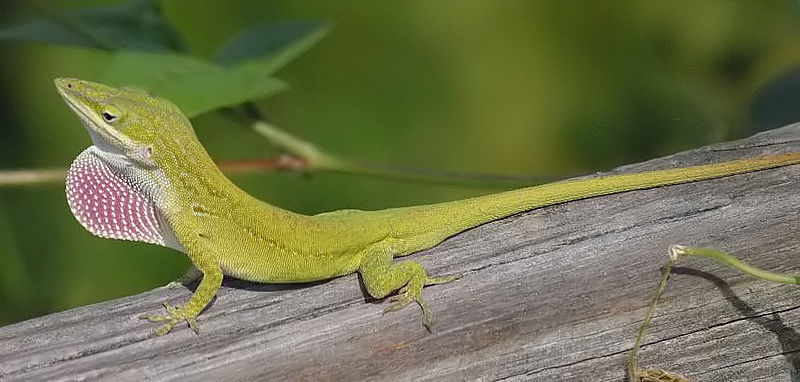
Once the anole has attracted a mate, he clasps her from behind and they remain locked together for some time. The female will begin to lay her eggs around 2 weeks later a few inches down in soft sandy soil or compost. The eggs hatch in 30 – 60 days, resulting in tiny baby lizards that rather seem to be all eyes and tail in the beginning. These babies must fend for themselves, as anoles take no interest in their young once the eggs have been laid.

Anoles are an excellent form of pest control as they feed on all sorts of insects, including mosquitoes. Larger anoles can take down fairly large insects, and it’s not an uncommon sight in the BioWorks Flight Encounter to see a Brown Anole in the process of eating a small butterfly, especially an older butterfly nearing the end of its life cycle.


Another fairly common sight is that of a lizard missing its tail. Anoles have the ability to release their tails when they feel threatened (i.e. when a cat or small child reaches out and grabs it). The tail itself continues to twitch for a minute or so, distracting the predator while the lizard makes its escape. The lizard will grow a new tail over the next few weeks to replace the one it has lost. This act of self-amputation is known as autonomy.
Like other reptiles, anoles molt (shed their skin), several times a year. During this time, the old skin begins to flake off, and you will see the lizard rubbing against bark and other rough surfaces to help remove the skin. Anoles frequently then eat this old skin, as it is a good source of nutrients like calcium.
No comments:
Post a Comment
We welcome your participation! Please note that while lively discussion and strong opinions are encouraged, the MOSI BioWorks Butterfly Garden reserves the right to delete comments that it deems inappropriate for any reason. Comments are moderated and publication times may vary.