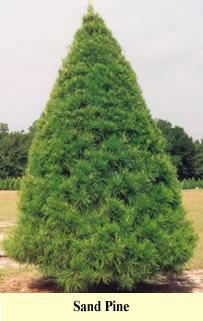
 For those who celebrate Christmas, one of the most important symbols of the season is the pine tree. Decorating an evergreen tree for Christmas festivities can be traced back as far as the 15th century, when revelers in Livonia danced around a spruce tree in the town square. Nearly six hundred years later, evergreens are still found in millions of homes around the world this time of year.
Florida has seven native species of pine, but most of them aren’t generally considered suitable for use as traditional Christmas trees due to their size and shape. The one exception is the Sand Pine (Pinus claus), which can be coaxed into the traditional pyramid shape if pruned properly as it grows, according to the Florida Christmas Tree Association. Sometimes called Scrub Pine, this tree grows well in sandy soils and has a strong root system that helps to prevent erosion. It’s generally found from Central Florida north.
 Another common Florida native pine is the Slash Pine (Pinus elliottii and its South Florida sub-species (Pinus elliottii var. densa). Few would think of using this tall, spindly tree as a holiday decoration, but the quick growth of this tree make it important to the lumber industry. These trees grow to maturity in about 30 years, and younger trees have value as pulpwood. In the past, the trees were an important source of resin and sap. Today, this could be considered Florida’s most important pine, with a huge economic value (the picture to the left shows a Slash Pine plantation) – but also a huge environmental value; the fast growth habit makes it excellent for restoration of natural habitats.
 Loblolly Pine (Pinus taeda) is similar in appearance to Slash Pine, and it is the most commercially important species in the southeastern United States. It grows as far north as New Jersey and reseeds so quickly as to be invasive in farming communities. You can tell the two species apart here in Florida by the location – loblolly pines prefer drier soil, while slash pines love moist areas – and by the number of needles, cones, and bark (learn more here).
 Longleaf Pine (Pinus palustris) was historically important to the logging industry, but the huge stands of this slow-growing tree that once dominated the state have now been greatly reduced. This pine takes up to 150 years to reach its mature size (compare to Slash Pine at only 30 years) and did not rebound from the heavy logging of the previous century. It forms an important part of the eco-system, thriving on periodic wildfires and providing habitat for wildlife. In fact, the Red-Cockaded Woodpecker (Picoides borealis) is so dependent on Longleaf Pine forests that the decline of the tree has meant the decline of the bird species – it’s now considered threatened.
Three of Florida’s native pine species are found only in the northern part of the state. Shortleaf Pine (Pinus echinata) is found in Florida only in the panhandle region. It prefers moist, fertile soils and sunny spots. Pond Pine (Pinus serotina) also loves the wetlands. However, its botanical name derives from the fact that Pond Pine also thrives on fire. In fact, it takes the heat from a wildfire to force open the cones of this tree. As wildfires and human habitation don’t generally go hand in hand, controlled burns will probably be required to help this species survive going forward. Pond Pine is found from Gainesville north.
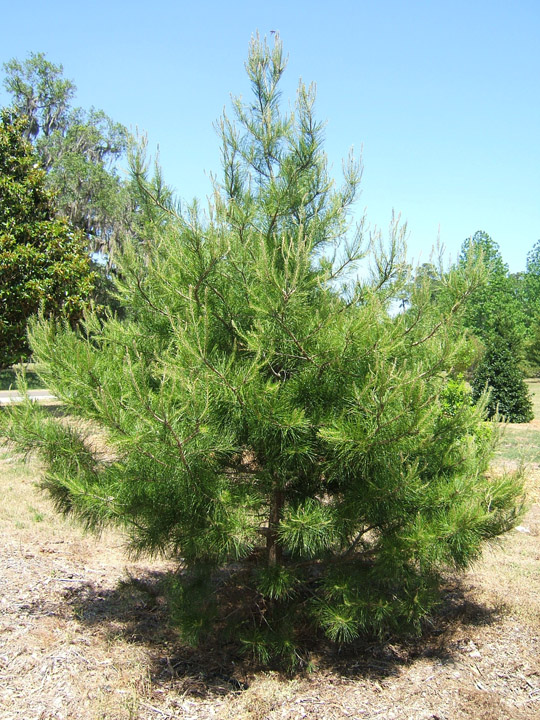 Spruce Pine ( Pinus glabra) is also found from the Gainesville area north and west through the panhandle. This species prefer the shade of taller trees nearby and actually grows poorly in full sun. It’s a pine of the wetlands, thriving in poorly drained or very wet soil. Don’t confuse it with the separate evergreen genus of spruce trees (Picea), which includes the popular Christmas tree species Blue Spruce (Picea pungens).
No comments:
Post a Comment
We welcome your participation! Please note that while lively discussion and strong opinions are encouraged, the MOSI BioWorks Butterfly Garden reserves the right to delete comments that it deems inappropriate for any reason. Comments are moderated and publication times may vary.